by Donnie Darko
This post was written on July 26, 2020.
Determined David
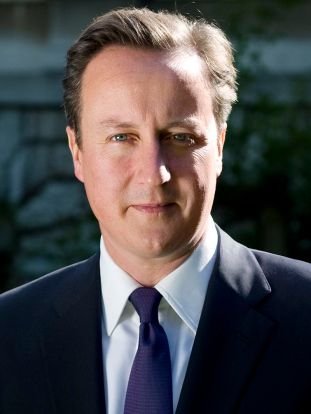
By 2010 there was a lot of concern boiling among everyday people that was electrified by the crisis brought on from the financial sector, but politicians remained clueless. These problems were not broadly evident or understood until elections in the middle of the decade. If politicians were aware of any of this and leading in front, then someone like David Cameron wouldn’t be out of politics today. A shining star in the Conservative party in the 2000’s, his popularity reached a crescendo in 2015, but he had a major blind spot. His fall was as quick as his rise and he is now out of the big picture. Aspirations he built all his life were crushed. His failure revealed all kinds of societal wounds to those among the populace that were not already conscious.
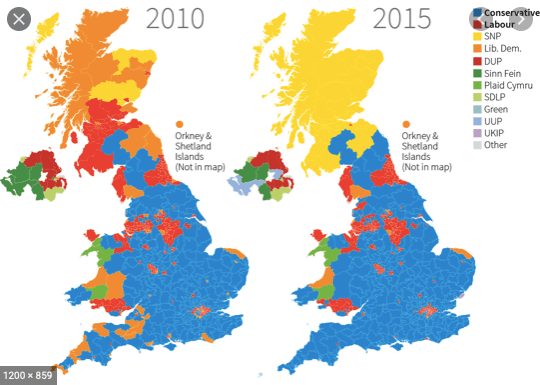
During the early part of the century the Conservative party in the UK was a struggling institution. The British political “right” was unable to dethrone Tony Blair even as he embarked on an unpopular alliance with America in the Iraq war. The Conservatives were in search of a new leader and after the 2005 election they found one in the young David Cameron. Criticised and lauded as a new Tony Blair or a chamaleon, the new Conservative leader appeared to be just a continuation of New Labour under Tony Blair. Nevertheless, with the British public growing tired of Labour rule they opted for a fresh young face with David Cameron in the 2010 election. Although not winning a majority, Cameron managed to put together a coalition with the Liberal Democrats where he could lead as Prime Minister. The new decade started with Britain electing its youngest leader in almost 200 years, even younger than Tony Blair was in 1997.
The outspoken anger against the financial sector weakened during the first few years of the decade and it had appeared public resentment had dissipated, or at least cooled off to acceptable levels. Politicians pressed on. In 2015 Cameron again led his party into another election. This time he surprised all of the pundits in winning a majority that was the Conservatives first in 23 years. The man was on top of the world. The gains were in large part thanks to a retreat from Lib Dem support.
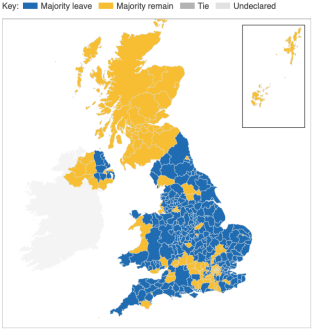
Yet his majority was tenuous and made more so with Cameron’s blind spot. Having been successful ending the Scottish question with the independence referendum of 2014 (in which ~55% voted stay in the UK), Cameron promised a referendum for the European Union question if he was elected in 2015. There was a sense of overwhelming confidence in the leader, with an approach seemingly treating the referendums as to be “done and dusted” and simply a formality that needed to “get out of the way to ensure a three-term legacy”. His efforts to negotiate with EU leaders fell short and he did not take the UK Independence Party’s influence seriously. He was not fully engaged with the issues outside of London.
The working class, a major component of the electorate in a country like the UK outside of London, was feeling left out. Cameron was often conflated as Tony Blair 2.0, which implied globalisation. The matter of globalisation was a major weakness of the EU from the standpoint of a low wage blue collar worker in Cleveland. Cameron was socially progressive at a time when a bottom up analysis of society would show deep frustration between the liberal educated elites telling those without a post-secondary education how to live and think. There were already whispers of racism before the referendum for anyone supporting the leave vote. People living in these English areas were only getting poorer after the financial crisis, now they were being told they were bad people too. Negative sentiment might have appeared to have cooled down, but everyone was about to discover it was merely festering silently.
We all know the result of the Brexit vote in 2016. Cameron cowardly resigned and eerily hummed a tune as he announced his farewell. His was a false rise. He shows how out of touch and stale politics of our era had become. He formed a policy framework that just continued those that had failed large segments of society for decades. Politicians chose to ignore the financial calamity endured outside of their bubbles. Thanks to the efforts of central banks, the rise in asset prices (that benefit few in the working class) helped to distract government from the realities of inequality that was steadily rising. Cameron was a privileged member of the Eton-Oxford class that was out of sync with what the times required. If anything, the 2010’s was the decade that killed politics as it had been for the better part of thirty years.
The 2010s ended with a political landscape that is heavily divided in Western Society and leaders that have no new solutions. Mr. Cameron’s fate is a useful representation for this period. The can’t miss candidate, according to old and steady rules that govern what makes one “electable”, who arrived too late on the scene and was too stubborn to step away from his formulaic message and assess the terrain outside of the boardrooms. Yet what was going on in people’s minds to warrant such a strong message being sent to the elites at this time? Had all of this been building for years on the ground, while those in their ivory towers were just that ignorant? If that is the case, then what are we to make of the recent social events that have exploded into the mainstream in 2020? If the political earthquake of 2016 was driven by a disillusioned citizenry that had been building for decades, what are we in store for next?
 Siloviki