by Donnie Darko
This post was written on July 30, 2020.
Conclusion
It has been said that politics is downstream from culture. Looking back, the 2010s would make a strong case for this. Politics was still appealing to people’s concerns of yesteryear. Social movements were gaining traction underground. The 2016 Brexit vote exposed just how out of touch politicians had become. But even by the time they tried to recover from those concerns, society had moved on to become even more divided. The decade ended with politicians grappling with how to appeal to these polar extremes and their respective movements. Our leaders started the decade feeling confident with central banks injecting the economy to calm the storm. They failed to dissect the original crime scene and assumed people would move on. They were wrong. Then they adjusted by either doubling down on status quo prevailing, or pretending to be the one to make necessary reforms.
Politicians may be reactive to the culture, but it should be noted that the root of all of the worries of the citizenry is derived from the financial markets. What started in 2009, has only led to policies that have exacerbated their fundamental concerns since – greater inequality. However, this is not as transparent to the non-financial elites as it was in 2009 and this segment of the population has distracted itself by targeting their anger at false enemies. While some people may be earning a higher wage, on a net basis their life isn’t improving. Young people increasingly can’t buy homes, they don’t own stocks (at least not enough to have a meaningful impact). Blue collar workers are still seeing factories shut down. Yet without an obvious and immediate financial crisis to point to, the people lack consciousness of the problem’s source. But this anger still needs an outlet.
If you look back in history, just recent history, you can find the signs of economic issues unconsciously leading towards revolutionary behaviour among peoples. Austro-Hungarian Empire? It was only the financial costs borne by the citizens at home during WW1 that led to a quiet revolution that ended Habsburg rule. Often times the nationality question in Austria-Hungary (see here as well) garners the most discussion about its collapse. Economic issues are often misunderstood or sidelined, not just with the general public, but the historians who study these themes. Thus the issue of nationality, race, etc. is just another distraction from what really led to the dissolution of the Empire. That is not to say it doesn’t serve a role, but its role is not as fundamental to what is really having an impact.
Though Austria-Hungary’s leadership was also responsible for the outbreak of the First World War, the Dual monarchy – like most of the other belligerent powers – was only prepared for short-term military operations. The repercussions from these expectations were already perceptible in 1915 when food was rationed in the Western, Austrian, part of the empire. The situation deteriorated in 1916 and after a bad harvest the supply reserves aggravated the severe winter of 1916/17. From autumn 1916 the number of riots due to hunger and even starvation increased.[7]
Germany as well. If you could weight all the reasons for the German people’s acceptance and adoration of Adolf Hitler, what would get the biggest weighting? For that, you really need to think about what life would be like with massive inflation and unemployment for over a decade. Then suddenly someone comes along, and whether or not you can link changes directly to that one individual, those problems are now gone. Do you really think such wide support exists because a leader projects confidence and patriotism? That means nothing without people’s wallets getting heavier. It works the same the other way. Russia was a poor country, but only got poorer in 1917. Similar to Austria-Hungary, its Empire collapsed, just more violently. They hated the Tsar in Russia, but it wasn’t until the Bolsheviks cried out with “Peace, land and bread” that people were willing to take a step into the abyss. It wasn’t a complicated political system people were looking for, just food. Money in their pockets to feed their family. That simple.
If I was to draw a simple masterpiece diagram (for a first grader) that shows the relationship of adventures during the decade for Hugh Hendry, David Cameron and Roosh and the themes they represent it would look something like this:
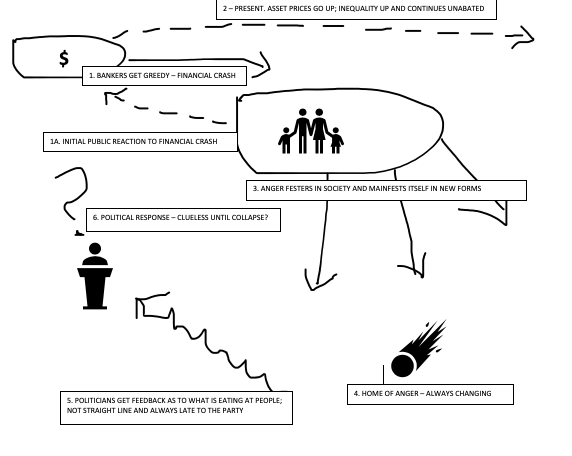
So Hendry took advantage of banker greed. But his style was worn out by the central bankers. He’s gone but cashed in. The financial crash created anger in society that, as time went by, manifested itself in such a way that ordinary people started to pay the price of this venom, not bankers. Roosh exemplifies this. Meanwhile you have the clueless politicians just hoping to keep things working as things have, because they clearly don’t understand how markets are impacting society and where this is going. They didn’t understand that, as Cameron exemplified, five years ago and they certainly don’t have any clue now.
The financial system we understood in 2010 is fundamentally different. Those that benefited from the previous system are quietly disappearing into happy retirement. The current structure appears out of control and is building up huge risk factors for everyone in the Western world if it comes crashing down again. The world leaders of the recent past are no longer viable. Sure, we have new leaders who came to power suggesting they would answer the call put forth in the middle of the decade, but they rest on the laurels of the stock market and seem only capable of leading from behind. There is nothing to find there. Meanwhile we are now seeing more cases like Roosh. Whether you agree or disagree with any one person, people are having their livelihoods and careers targeted by their own peers. This appears to be unhelpful and misdiagnosed. It appears that to really understand what is upsetting someone in Western society, you must start with the financial picture. If that doesn’t get resolved, problems will ‘snowball’. Meanwhile, the politicians are just actors in a play that is being written for them. They have no control and will receive praise or condemnation accordingly. Woe betide anyone that seeks a saviour in them.
 Siloviki