By Jim Malone
This post was written on September 1, 2020.
I have been on a journey since being made unemployed by Covid in the Spring. The ideal destination in my mind is a “Portfolio Career”, or the flexibility to do several things or have multiple sources of income. Independent consulting is something I had considered, but remained focused on contacting existing businesses I am attracted to with the goal of seeking part-time (preferable) or full-time (would live with it if I liked the business) work. Any focus on freelancing would come after this. However, my meeting with a former curmudgeon, now relaxed business owner changed my outlook.
I was on a call with an ex-colleague who had been freelancing for over a year. If you had just met this man you would likely have described him as very confident, positive and self-assured about what he was doing. However, this would not have been how you would have described him two years ago. The words angry, bitter, unassured and resentful come to mind. It was then that I realised that being an independent freelance consultant isn’t any more scary than regular employment. It comes with headaches and inconveniences but, at least to me, these are outweighed by the case for it.
- Freelancing enables me to test out its viability, while not closing off the possibility of full-time, regularly paid work. However, taking a full time job today severely limits my ability to freelance or consider other options.
- Independence will allow variability in my duties, something that is highly attractive to me. Full time work has exposed a pattern of providing genuine interest for about a year, before it becomes repetitive and boring.
- If I find myself working with clients that are displeasing or have a highly politicised culture that creeps into projects, I don’t have to work with them again. I can’t escape the politics of a full-time employer, I become embedded in the game even if I don’t want to. The alternative is to quit and start the process all over again, so I would end up behind where I would be otherwise.
- I can work from home or wherever suits me best when I’m out on my own. Permanent employment takes that flexibility out of my hands.
- I can work my own schedule and when my efficiency is maximised. While under regular employment I am likely bound to 9-5 or, worse, deploying significant “face time”.
The big negative for contracting is the fact you have to eat what you kill, which means you alone are responsible for going out and doing the killing. However, it is a facade of security that regularly paid work gives you. You can lose your job at any time, and without any notice. Sure, you can build something on the side. Given my scenario finding full-time work so I can build something on the side is counter-productive. I would be working backwards and not forwards from my perspective.
The other aspect I realised is that for years I had been applying blindly for jobs. In reality, I know these companies about as well as the dog walker next door. It’s all desktop knowledge. It doesn’t take long before going in that I realise it isn’t a fit with my values or desires. Or that my superior is not someone I can learn from. Or that I will not be as busy or important in this job as they made it sound. If I want full-time work eventually, it makes much better sense to do a few projects and get to know someone before committing long-term. We do this for dating, why don’t we do this for work? We even test drive cars but those are hardly life-altering decisions. Which leads to the best part: just because I’m trying to freelance, doesn’t mean I can’t consider full-time work if the former isn’t working as I had hoped.
If you are keeping score at home that is 6-1 in favour of freelancing if I can count correctly? Let’s even give “stable income” 4 points and it’s still 6-4 for independence!
Most importantly, freelancing operates at the centre of the “Portfolio Career” model, as I see it, and offers maximum flexibility to pursue this. Here’s a half-witted diagram to help better articulate my thoughts:
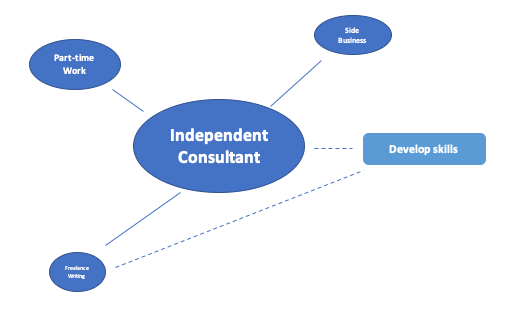

What you see in Figure 1 is how I view the beginnings of a Portfolio Career. Note that just being an independent consultant is not in itself a portfolio, but it is the centre from where everything else can branch out from. The sizes of the circle indicate amount of time allocated to one particular role. The length of lines from the centre indicate how different the other roles are to what you do as a consultant.
Figure 2 displays the flexibility of this model. If being an independent freelancer is the centre of things, you can easily lighten its workload to expand other areas. Perhaps you are developing other skills, such as freelance writing, and you devote more time to this? All the while you are building new skills or developing old ones. The lines depicted form that box indicate how foreign the skills are. The closer they are to the role, the more familiar they are. Thus, in Figure 2 you could be adding to your repertoire as a consultant with new skills, hence this line is further away than it was in Figure 1. Meanwhile your writing skills are becoming more adept, so this line is moving closer in Figure 2 – you’re merely improving an existing skillset.

The point is, starting out with the freelance option at the centre of your portfolio offers maximum flexibility. No detailed business plans and financing to arrange, no part-time roles to interview for, no skills needed to be proven.
It should also be stressed that office politics is something I loathe perhaps more than anything in life. If I was to weight my points (which you should do if you are ever considering pros and cons for your career options – each category always carries different levels of importance for everyone), I would apply 70% for the ability to limit these unpleasant experiences. I realise there will always be an element of dealing with aspects of politics no matter what you do, but in my experience this has grown like a cancer in almost every company I have worked for. CEOs might not intend it that way, maybe they participated in it to get to the top, maybe not. However, those meddling middle managers are highly protective as these are often individuals most unwilling to ever start a business. They’ve staked their entire livelihoods on climbing the ladder. It is toxic. Even worse, too many “experts” focus on “promotions” and propagate office politics as necessary to get ahead. No matter what, one thing I am learning (I mean really understanding, not just saying or hearing) is that if there is something you value highly when it comes to work, make sure it is being addressed. You’ll live a shorter life otherwise.
It was by coincidence that one of my other contacts I reached out to is also freelancing. He kindly offered me practical advice and shared his experiences. It was the nail in the coffin and I have decided to go for it. Two conversations changed my outlook, so always reach out to people that have been put in the same position as you. In this case – found themselves, and not by choice, unemployed and pursued something independent applying skills built over their career.
So a week later I set up a limited company, my own email account, got in touch with an accountant and registered profiles on professional consulting platforms. I developed a database of personal contacts from my career that I would like to reach out to. I set up meetings with others who have taken this journey, to learn from them as well. I will, at the same time, contact that same shortlist of companies described in Episode 3, but with a different angle than originally intended. I’m only looking to start a relationship. Where it will lead is dependent on time, rapport and circumstances. There is no agenda.

The thing to recognise if you ever go this pathway is that you have to believe you have something to offer, and everyone with experience always does. If even my grumpy-turned-optimistic friend can build the confidence to achieve a steady freelance career, then anybody can.
Developing a “Portfolio Career” is still something I care deeply about. But it has to start with trying something and freelancing is what I have decided to start with. My experiences are unique. I have been a part of so many massive failures (starting with Enron) that I know a thing or two about organisational disaster and what we can learn from it. Perhaps I can start my journey by advising organisations, large and small, about how they can limit the toxicity of office politics? It truly can be a destroyer of value. That would be a welcome irony.

 Siloviki